

As much we may fear premature death from cardiovascular disease or cancer, the decline in mental functioning, the distress, confusion and dependency on others that results from Alzheimer’s and other forms of dementia is something that many of us dread.
The Problem of Dementia and Alzheimer’s Disease
For all the developments in medical research, dementia is becoming more prevalent in our society today and is set to rise further. Already dementia is the largest killer in the UK, far outstripping deaths from heart disease or cancer. It also affects women disproportionately. Around twice as many women have Alzheimer’s disease – the most common type of dementia – compared to men. And it won’t surprise you to learn that most of the burden of caring for those with dementia also falls to women.
Patrick Holford on Alzheimer’s Disease
I recently came across a couple of interviews with Patrick Holford about his work on preventing dementia and Alzheimer’s disease, and it’s so important that I want to share it far and wide. I’d urge you to listen to one of these interviews, such as the one below with Liz Earle (and further links at the base of this article).
Contrary to what many of us have come to believe, according to Holford, only 1% of Alzheimer’s is directly caused by genetics. He asserts that our modern lifestyle is now so far removed from our evolutionary roots, that it is damaging our brain and nervous system. However, the good news is that we can make lifestyle and dietary changes at any stage of life than could markedly reduce our risk of dementia and improve our cognitive functioning! If you read no further, check out the 8 key protective factors below:
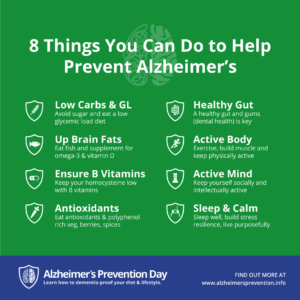
What I love about Holford’s approach is that it is holistic; he recognises that brain health is the interplay between:
- Structure: you need all the key ingredients to make healthy nerve cells
- Function: you need all the ingredients to allow the brain to function at its best, both nutritionally and also to detox and interact as part of the greater system
- Utilization: you need stimulation for the brain in a wide variety of ways and a reason to get up in the morning
Key Elements of Holford’s Approach
Optimize brain nutrition:
- Omega-3 fatty acids: Found in abundance in fish oils, these are crucial for maintaining cell membrane integrity and reducing inflammation in the brain. DHA (docosahexaenoic acid) is particularly important for brain function and EPA (eicosapentaenoic acid) for mood.
- B vitamins: Folate, B6, and B12 are vital for brain health in their own right, as well as for reducing homocysteine levels. High homocysteine levels are associated with increased risk of Alzheimer’s. B6 and B12 are found in animal foods, especially meat, fish and eggs.
- Importantly, you need BOTH adequate B vitamins and omega-3s as they work together synergistically to maintain brain health.
- Antioxidants: Vitamins C and E, and other antioxidants, help combat oxidative stress, which can damage brain cells. Foods rich in these nutrients, like colourful veggies, berries and leafy greens, are recommended.
- Healthy fats and fat-soluble vitamins incl. vitamin D: Incorporating sources of healthy fats, such as fish, nuts, avocados and olive oil supports brain health.
- Regulate blood sugar: Insulin resistance and type 2 diabetes are linked to an increased risk of Alzheimer’s, which is sometimes referred to as ‘type 3 diabetes’. To manage blood sugar levels, eat a low glycemic load (GL) diet, and avoid sugary foods and high-carb foods.
- Gut health: Optimize your microbiome with fermented foods and/or probiotics and prebiotic foods.
- Phospholipids and choline: These can be found in abundance in eggs, fish and meat.
Embrace the following:
- Regular exercise: Physical activity enhances brain function, reduces inflammation, and improves mood. Both aerobic and strength training exercises are important. Forms of exercie that require memory, coordination and social interaction such as dance classes or team sports are ideal.
- Mental stimulation: Activities such as puzzles, learning new skills, and engaging in social interactions can help maintain cognitive function and build brain resilience.
- Stress management and sleep: Chronic stress can negatively impact brain health. Techniques such as mindfulness, relaxation exercises, and adequate sleep are essential.
Minimise risk factors:
- Lack of brain stimulation: Lack of social interaction, the formation or cataracts or other visual impairments and hearing loss are all shown to increase risk of dementia — therefore it is important to do all you can to protect and enhance your special senses, getting cataract surgery if and hearing aids if necessary.
- Avoid or minimize neurotoxins: substances and environments that can harm brain health, such as smoking, excessive alcohol consumption, and environmental pollutants.
Should I supplement?
Even if you are an omnivore that enjoys a wide and varied diet, you may still benefit from supplementing a few of the key nutrients. It used to be traditional to have fish on a Friday but this, along with cod liver oil for children, has fallen by the wayside. Upping the oily fish content of your diet is ideal, especially the smaller fish, but most of us would still benefit from a fish oil supplement to get our omega-3s up. The full complement of B vitamins can be readily obtained from a diet that includes fish and animal food sources, but as we age our body becomes less good at absorbing B vitamins. Likewise, older skins are less effective at making vitamin D in the sun so a supplement can help year-round, and, of course, we can all benefit from one through the winter. It’s easy to check your levels of the key brain nutrients if you are not sure (see Home Test Kits, below).
What if I’m vegetarian or vegan?
Most of the B vitamins, omega-3s and choline are predominantly from marine or animal foods, so vegetarians and, even more so, vegans, need to be careful to supplement sufficiently. To cover the omega-3 issue, algae-derived omega-3 (DHA and EPA) supplements are essential, in addition to dietary sources such as flaxseeds, chia seeds and walnuts. Also ensure adequate B vitamin intake. Vitamin B supplements, especially B12, are essential; some intake can come from fortified foods and fermented foods, but supplements offer more reliability. Veggie sources of folate include leafy greens and legumes and B6 can be found in bananas and chickpeas.
Food for the Brain Foundation
Is your diet is giving you all the right brain nutrients? Are you doing enough exercise or getting enough social or mental stimulation? What if you don’t know where to start? The Food for the Brain Foundation is a charity set up by Holford that aims to help answer these questions for individuals as well as build a biobank of data from ‘citizen scientists’ – individuals that engage with what they offer – that will ultimately help researchers learn more about lifestyle, diet, aging and cognition.
Cognitive Function Test
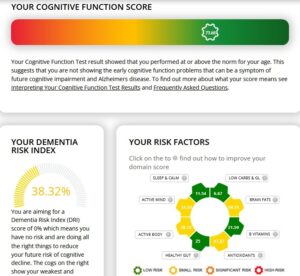
At foodforthebrain.org you can do a free Cognitive Function Test, which includes and follow-on lifestyle questionnaire, to point you in the right direction. Sounds scary! Feeling rather trepidatious, I thought I’d give it a go! After completing the test and questionnaire, the website spits out your results and points you in the direction of how you can reduce your personal risk further through specific changes in diet and lifestyle. Here’s mine below. The brain seems to be OK but I have some lifestyle areas for improvement!
Home Test Kits
What I think is even more useful, is that you can buy home test kits for the key nutritional markers for cognitive health to measure your homocysteine (B vitamin status), omega-3, vitamin D, HbA1c (glucose control) and glutathion index (antioxidant status). This really allows you to know how to fine-tune your diet to make it brain friendly. And this data feeds into the biobank project too.
Education
The foodforthebrain.org website provides links to a range of free resources including articles, postcast episodes, books, events and more. It not only covers Alzheimer’s disease but also has information on nutritional support for other brain and neurological disorders. You can also support their work by donating or becoming a ‘friend’ of the charity.
Resources
Website:
Interviews and Talks:
Patrick Holford talking to Dan Astin-Gregory: This ONE Thing Could Transform Your Brain Health (1h 06 mins)
Patrick Holford at Low Carb Down Under: What’s driving Alzheimer’s? (41 mins)