
Can water be 'structured' to be healthier and more coherent? Does water carry memory?
We all know that staying hydrated is important to staying healthy, and access to clean, uncontaminated water is essential, but as a homeopath, I'm interested in the possibility that water can hold information at a more subtle level that is currently recognized by the mainstream biomedical paradigm. After all, when we dilute homeopathic remedies to the centesimal ('c') potencies, not a single molecule of the original substance is likely to be left in the remedy!
In this article, I'll introduce you to three areas of research or ideas about water that may surprise you. It's not my intention to come up with an overarching theory or even relate it directly to homeopathy. Rather, it's a gathering together of fascinating concepts about water that exist. It may open your mind to the idea that there are far more subtle energies at play in our world that is acknowledged by the current widely accepted science.
Below is a whistlestop tour of:
- The fourth phase of water (EZ water)
- Structured water through vortexes
- Memory of water
The fourth phase of water (EZ water)
The fourth phase of water or exclusion zone (EZ) — water, proposed by Gerald Pollack (University of Washington, Seattle) is a structured phase of water that appears to form next to hydrophilic (water-attracting) surfaces such as cell membranes. Unlike ordinary water, EZ water has a gel-like consistency, is more ordered, and carries a negative charge, while the surrounding water holds a positive charge, creating a battery-like potential.
 Dr Pollack calls this the 'fourth phase of water' (beyond solid, liquid, and vapour). It is characterized by its ability to exclude solutes and particles—hence the name 'exclusion zone'. It expands in response to light, especially infrared.
I would like also to name-check Professor Gilbert Ling, on whose theoretical work Dr Pollack's lab work builds, and whose Association-Induction Hypothesis, challenges the prevailing view of cell membrane structure and function.
It is possible that cellular processes, protein folding, and even energy generation in cells may rely on this structured water. It may play a role in biological self-organization. If validated further, these ideas could transform our understanding of biological systems at the cellular level.
Structured water through flow and vortexes
This theory suggests that water can organize itself into a more coherent, energized, and life-supporting structure when it moves in natural, spiralling motions—like those found in mountain streams, whirlpools, or even man-made vortex devices.

Photo by Manuela Adler
When water flows in a spiral (a vortex), it experiences centrifugal and centripetal forces that can reorganize its molecular structure. This motion supposedly clears impurities, aligns molecules, and creates hexagonal or other coherent patterns—sometimes called ‘liquid crystals’ or ‘structured water’. Proponents believe this vortex action re-energizes water, restoring its ‘vitality’ lost through stagnation or straight-piped systems. It is thought that vortexing helps water ‘remember’ and return to its natural, harmonious state, potentially retaining beneficial information or electromagnetic imprints.
In mountain streams or rivers, water tumbles and spirals over rocks, constantly forming vortexes. This dynamic movement is believed to charge the water with energy, oxygen, and structure, making it more beneficial to living organisms.
Key figures in the development of this idea include: Viktor Schauberger (1885–1958); Theodor Schwenk (1910–1986) and more recently Callum Coats.
Memory of water
Luc Montagnier, a Nobel Prize-winning virologist, conducted controversial experiments in the 2000s and 2010s that, he claimed, supported the idea of a ‘water memory’ or a structural imprint left by DNA in water. He found that DNA sequences could emit low-frequency electromagnetic signals (EMS) in water at high dilutions and that these signals could be digitally recorded, transmitted electronically, and then used to recreate the original DNA sequence in water mixed with enzymes, primers, nucleotides.
Prior to this, in the 1980s, Jacques Benveniste and his team reported that human basophils (a type of white blood cell) would react in response to a solution of anti-IgE antibodies, even when the solution was diluted to the point where no antibodies should remain. Although both bodies of work are controversial in the mainstream, homeopaths often cite these researchers’ work as the closest we have so far to illustrate the power of homeopathic-level dilutions in the laboratory.
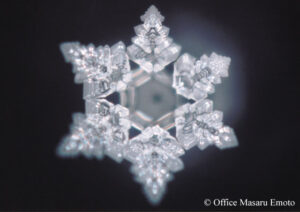
‘Hope’ from the library of Masaru Emoto
Coming from a more esoteric and heart-based approach, Masaru Emoto, a Japanese author and researcher photographed water crystals after exposing them to various stimuli (words, music, prayers). He concluded that water could store information from thoughts, emotions, words, and music. He claimed that water exposed to positive energy—like love, gratitude, or uplifting music—forms beautiful, symmetrical crystals when frozen, while negative influences produce distorted or chaotic patterns. Currently Veda Austin, a New Zealand-based artist and water researcher explores water’s visual response to intention and imagery. She has developed methods of flash-freezing water to reveal patterns she believes are intelligent responses to thoughts, people, or environments. Both these people claim to illustrate water as a sensitive, responsive medium that reflects the energy and consciousness it interacts with. This led to the idea that water can ‘remember’ emotional or vibrational imprints even after the original source is gone.